

Part 3 of QPMN’s Web3 Phygital Series. Part 1 explains why Web3 brands are replacing static apparel with randomized phygital trading cards. Part 2 covers producing collector-grade booster packs with zero inventory. Part 3 is the technical and commercial blueprint for connecting your burn-to-redeem portal or token-gated storefront to QPMN’s B2B2C print-on-demand fulfillment platform.
Quick Answer: NFT burn-to-redeem fulfillment converts an on-chain token burn into a shipped physical collectible. Your portal validates the holder's shipping address and collects shipping payment before the holder signs the burn transaction. Once the burn reaches ledger finality, your backend sends a JSON order to QPMN's platform (or syncs via Shopify) so orders can be submitted for on-demand printing, randomization, sealing, and white-label shipping.
The Post-Mint Bottleneck: Why Web3 IP Owners Need a Specialized B2B2C Card Platform
When your holders burn a liquid NFT, they expect a retail-grade, foil-sealed physical pack at their door—and they will post either the unboxing video or the complaint on X. Minting digital scarcity takes minutes, but delivering physical trading cards worldwide is where most Web3 projects hit an operational wall. Projects that prepare early gain a major advantage in logistics and production, because "physical products take way more time than anything onchain," XPUNKs creator Kaj Leroy noted in an October 18, 2026 U.Today report, citing figures from his hybrid XRP Ledger project, Fuzzycards, which issued about 100,000 booster packs that NFT holders burned to have physical cards delivered.
Even the largest Web3 studios face this post-mint delivery gap. On October 17, 2026, Yuga Labs launched Mudwater (Swamp Origins) on Solana—a fixed supply of 240,000 ten-card packs (2.4 million physical cards across 120 designs) printed by Orange Cap Games and backed in a vault. While Bored Ape and Mutant Ape holders could claim packs cross-chain via ERC-6551 Totems and Chainlink CCIP (with digital pack opening priced at 8 USDC), converting digital cards into delivered physical cards remained listed as a planned 10 USDC physical-conversion fee in late October 2026 reporting.
To turn digital redemptions into recurring physical revenue, Web3 IP owners need more than a traditional factory demanding 20,000-pack minimums or a generic merch broker that only prints t-shirts. You need a specialized B2B2C print-on-demand platform purpose-built for randomized TCG booster packs, collectible trading cards, tokenized sports and NIL rosters, and encased 1-of-1 singles. Through QPMN’s Physical NFT Card Printing & Redemption Fulfillment platform, your orders route directly into the industrial printing plants of our parent company, Q P Group (HKEX: 1412)—letting you print, randomize, seal, and white-label ship collector-grade cards on demand or from a presale batch.
QPMN Web3 Redemption Specifications at a Glance
| Fulfillment Parameter | Verified QPMN Platform Specification | Official Reference Page |
|---|---|---|
| Platform Role & Parent Manufacturing | B2B2C Print-on-Demand Platform backed by publicly listed parent Q P Group (HKEX: 1412, founded 1985); produced in QP Group's plants in Dongguan, Heshan (China) & Ninh Binh (Vietnam). | About QPMN |
| Minimum Order Quantity (MOQ) | No minimum (Zero MOQ); order starting from 1 pack, scaling to enterprise volume runs. | Custom Booster Packs |
| Supported Collectibles & Modes | 1) Randomized Booster Packs (TCG, Collectible & Sports Cards) 2) 1 NFT = 1 Unique Card / Fixed Set (reviewed & confirmed with QPMN per project) 3) Encased Single Cards (2.5" × 3.5" in magnetic one-touch case) |
NFT Print on Demand / Trading Cards |
| Cards Per Booster Pack | 1 to 23 cards per pack in standard randomization guide (maximum capacity 21–29 depending on stock thickness; up to 10 cards on SL35 Glass Layer). |
Randomization Guide |
| Cardstocks & Printing Effects | 10 cardstocks (including 400gsm ES40 & SL35), 17 printing effects (8 foil patterns front/back), custom paper or foil wrappers. |
Custom Trading Cards |
| Order Routing & API | Native apps for Shopify, WooCommerce, Etsy, Squarespace, or QPMN Custom API (per-product API Document & DesignSchema). |
API Integration Guide |
| Production & Presale Storage | 2–5 business days on-demand production, OR Presale Batch Warehousing (first 3 months storage & handling fees waived). | Warehouse Fulfillment |
| Shipping & Published Checkout Policy | Generally 7–12 days shipping (tracking numbers for US/Canada; recorded delivery documentation elsewhere). 10% US Import Service fee at checkout; no customs bill on delivery. | QPMN Official FAQ |
Planning a physical NFT drop or presale? Request your per-product API Document and tailored redemption quote →
1. Aligning Tokenomics with Fulfillment: 3 Scalable NFT Redemption Models for Booster Packs, TCGs & Sports Cards
Short answer: Choose your redemption architecture based on what the token represents and which blockchain you use. A pack token redeems for a randomized physical booster pack (Model A). Arevealed card token redeems for that exact physical card (Model B). A token-gated community drop unlocks holder-only cards on Shopify without burning the NFT (Model C).
Before scoping your integration, note who QPMN is built for—and who it is not for:
- Built for Original IP Owners (Not Vaulted Slab Resellers): In its September 28, 2026 market report (Trading Cards Move Onchain), Re7 Research estimated that major on-chain TCG gacha platforms were running at roughly USD 3 billion in annualized gross revenue.
However, secondary-market gacha platforms (such as Collector Crypt or Phygital) vault existing graded Pokémon slabs and trade digital claims on them. QPMN does not vault secondary-market slabs and does not operate your burn contract or hold wallet keys. QPMN is the B2B2C print-on-demand platform for projects that own or license their IP and need brand-new physical booster packs, playable TCG decks, custom sports cards, or encased singles produced and shipped.
Comparing the 3 Web3 Redemption Models & Connection Paths
| Redemption Model | What the Holder Does | Supported Chains & Trigger | QPMN Platform Setup & Fit |
|---|---|---|---|
| Model A: Pack NFT → Randomized Physical Pack | Burns or claims 1 pack NFT on your portal to receive 1 sealed blind physical booster pack. | Any Chain (XRPL, Solana, Ethereum, Polygon, etc.) via Custom Burn Portal + QPMN API. | Configure rarity groups and slot probabilities once in QPMN's Card Randomization Tool; synced orders trigger automated collation and foil sealing. |
| Model B: 1 NFT = 1 Exact Physical Card (or Fixed Set) | Reveals traits on-chain, then burns/claims a specific card NFT to get that exact physical card. | Any Chain (on-chain VRF or trait reveal prior to redemption) via QPMN API. | Supported, reviewed and confirmed with QPMN per project (using SKU WITHOUT DESIGN & DesignData, or Encased Collectible Single Cards). |
| Model C: Token-Gated Storefront (No Burn Required) | Connects wallet on Shopify to unlock holder-only booster packs, TCG decks, or sports cards. | EVM, Solana, Tezos, Flow via Shopify token-gating apps (No off-the-shelf XRPL Shopify app → use API). | Connect your store to the free QPMN Shopify / WooCommerce App for zero-code order routing and Split-Fulfillment. |
Which integration path fits your drop?
XRPL or any on-chain burn → Custom Portal + QPMN API (Model A or B).
EVM, Solana, Tezos, or Flow ownership check with no burn → QPMN Shopify App (Model C).
Upfront Pre-Print vs. Print-at-Redemption vs. Presale Batch Warehousing
When launching a 100-pack pilot or a 60,000+ pack physical drop, how you structure inventory dictates your cash flow. Instead of pre-printing 100% of your supply before knowing how many holders will redeem, QPMN’s NFT Print-on-Demand platform and Dropshipping & Warehouse Fulfillment Service give you two capital-efficient fulfillment options:
| Operational Factor | Upfront Full-Supply Pre-Print & Storage | QPMN Mode 1: On-Demand Print at Redemption | QPMN Mode 2: Presale Batch + QPMN Warehouse |
|---|---|---|---|
| Upfront Capital Required | Entire Print Run Upfront Pay for the full edition size before any holder redeems. |
Zero Upfront Inventory Pay only as holders redeem (combining same-spec synced orders via FlexiBulk™). |
Funded by Digital Presale Close your NFT presale first, then produce the agreed batch at bulk rates. |
| Unredeemed Tokens & Storage | Unclaimed Stock Sits in Storage Cards for unredeemed tokens remain in storage until claimed. |
Zero Unclaimed Stock If a holder never burns their token, no pack is printed. |
First 3 Months Fees Waived 0% storage and handling fees for the first 3 months in QPMN's warehouse (15% charge on remaining goods value after). |
| Dispatch Speed & Best Use Case | Suits fixed retail box releases where 100% of stock is pre-allocated. | 2–5 business days production + generally 7–12 days shipping. Ideal for ongoing redemptions & 1-of-1 cards. | Same-day warehouse readiness as orders arrive. Ideal for phased presale drops with agreed batch quantities. |
Next Step in Your Architecture: Once you select your redemption model and inventory mode, your next priority is security: how do you connect your holders' wallets to QPMN's fulfillment platform without exposing your smart contracts or losing money on failed burns?
2. Zero-Custody Burn-to-Redeem Fulfillment: Automating XRPL & Solana Delivery Without Exposing Your Smart Contract
Short answer: A burn-to-redeem portal collects and validates the holder’s shipping address and shipping payment first, then prompts the wallet to sign the on-chain burn. Once your backend verifies ledger finality and confirms the token ID is unredeemed, it sends a standard JSON print order to QPMN. QPMN never touches your smart contract or wallets.
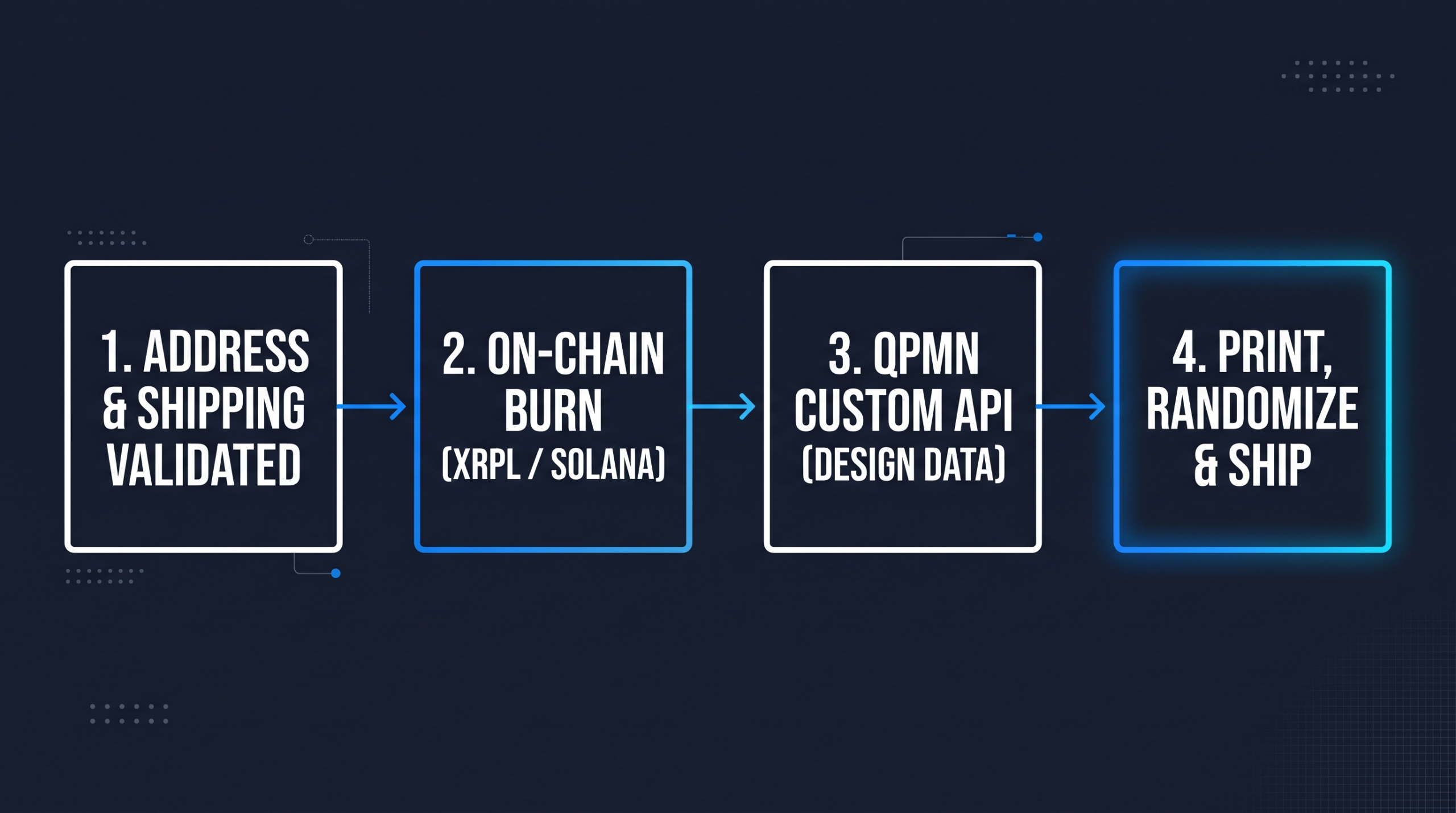
NFTokenBurn) or Solana burn prevents orphaned redemptions
while keeping smart-contract logic completely decoupled from QPMN's API.
The 8-Step Custom Redemption Portal Flow
- Wallet Connection: The holder connects their wallet (e.g., Xaman or Crossmark on XRPL, Phantom on Solana, or MetaMask/WalletConnect on EVM), and your portal lists eligible tokens.
- Address Validation & Shipping Payment: The holder enters their delivery address. Your portal validates the address and collects shipping and applicable import fees upfront.
- Pending Redemption Lock: Your backend creates a database record linking the
token_id, validated address, and payment receipt under a uniqueredemption_idwith statusawaiting_burn. - On-Chain Burn Signature: The portal constructs the burn transaction for that exact token—embedding the
redemption_idin the transaction memo—and the holder signs. - Finality & Collection Verification: Your backend waits for ledger finality, confirms the burned token belongs to your official collection, and verifies it has not been redeemed previously.
- QPMN Order Sync & Submission: Your backend sends one JSON order to the QPMN Custom API, passing
redemption_idas your external order reference. Synced orders transfer automatically to your QPMN dashboard, where your team submits them (individually or combined in batches) for production. - Production, Collation & Sealing: QPMN routes the order to QP Group’s printing facilities to print the cards, collate configured rarity tiers (Model A) or agreed fixed card faces (Model B),and heat-seal the custom paper or foil wrapper.
- White-Label Dispatch & Delivery Documentation: QPMN ships the parcel in generic white-label packaging with no QPMN branding, supplying tracking numbers for the US and Canada and recorded delivery documentation for other destinations so your portal marks theredemption shipped.
Architectural Boundary: What QPMN Does vs. Does Not Do
- What QPMN Does: Provides the B2B2C print-on-demand platform, algorithmic card randomization builder, e-commerce/API integrations, card production (via parent QP Group), wrapper sealing, and white-label shipping.
- What QPMN Does Not Do: QPMN never reads your blockchain, never holds wallet keys, never executes or verifies token burns, never links wallet addresses to home addresses, and never decides third-party grading slab eligibility. Your cryptographic custody remains 100% inside your own infrastructure.
How to Redeem an XRPL NFT for a Physical Card
For projects building on the XRP Ledger (using the native XLS-20 NFToken standard), your redemption backend should enforce four protocol checks:
Holder Burn vs. Issuer Burn (
NFTokenBurnFlags): Under the XRPLNFTokenBurntransaction, the current token owner can always burn their NFT. If your collection was minted with thetfBurnableflag (Flags = 1for burnable only, orFlags = 9for burnable + transferable), the issuer or authorized minter can also execute the burn after the holder signs an off-chain ownership proof and submits their shipping address—eliminating "burned but no address" edge cases.Wait for Validated Finality (
tesSUCCESS): Only trigger a QPMN print order when the burn transaction appears in a validated ledger (validated: true) with transaction resulttesSUCCESS. Inxrpl.js,client.submitAndWait(tx, { wallet })awaits ledger validation automatically.WebSocket Stream vs. Wallet Callbacks (No Native XRPL Webhooks): Because the XRP Ledger does not push HTTP webhooks natively, listen to validated ledger streams via WebSocket (
subscribemethod on your issuer/collection account) or capture the signed transaction hash from your wallet SDK callback, then verify it directly against an XRPL node before calling QPMN.Cryptographic Order Binding (
Memos): Encode yourredemption_id(in hex) inside the XRPL transaction’sMemosarray (MemoData) so every on-chain burn points to exactly one physical shipping record.
How to Redeem a Solana or Cross-Chain NFT for a Physical Card
- Require finalized Commitment: Per Solana’s transaction commitment documentation, RPC nodes report three states: processed (can still roll back), confirmed (supermajority vote), and finalized (rooted and irreversible). Only dispatch a physical print order to QPMN once the burn transaction reaches finalized status.
- Verify Collection Authority: Before accepting a burn, verify on-chain that the burned mint address belongs to your verified Metaplex collection address (or Token-2022 group) so attackers cannot burn an unauthorized token to trigger a physical pack shipment.
- Bind via SPL Memo Instruction: Append an SPL Memo instruction containing your redemption_id to the same atomic transaction that burns the token.
- Cross-Chain Redemption Decoupling: As seen in Yuga Labs’ Mudwater drop (where Ethereum holders burned ERC-6551 Totems via Chainlink CCIP to receive Solana packs), keep your QPMN fulfillment logic independent of any single chain. Once your database verifies the burn on XRPL, Solana, or Ethereum, the JSON order sent to QPMN is identical.
What This Means for Your Project: Because QPMN operates on a strict zero-custody boundary—receiving only a standard Web2 print order after your backend verifies tesSUCCESS on XRPL or finalized status on Solana—you can expand your physical collectibles roadmap across new chains without rewriting your fulfillment pipeline.
But what if your drop doesn't require burning the token? If your goal is to reward holders with exclusive booster boxes, playable TCG decks, or sports card sets while letting them keep their NFTs in their wallets, you can launch even faster with zero custom backend code.
3. Speed to Market Without a Burn Portal: Launching Token-Gated Shopify Print-on-Demand Drops
Short answer: For projects on Ethereum, Polygon, Solana, Tezos, or Flow that do not require an on-chain token burn, a Shopify token-gating app verifies the holder’s wallet and unlocks an exclusive product page. When the holder checks out, the free QPMN Shopify App automatically routes the order to QPMN for printing, randomization, and white-label shipping.
- Install the QPMN Shopify App & Set Store Currency to USD: Install the QPMN Shopify Print-on-Demand App (zero setup fees and zero monthly subscription fees). Per QPMN’s Official FAQ, QPMN currently processes orders in US Dollars (USD) only—so set your Shopify store currency to USD while setting up the QPMN Shopify App to avoid currency error code 300310 (once setup is complete, you may change your storefront display currency).
- Publish Your Booster Pack, TCG Deck, or Sports Card SKU: Create your randomized booster pack or custom trading card product in QPMN and sync the gated variant to your Shopify store.
- Apply Wallet Token-Gating & Check Chain Compatibility: Gate the Shopify product using a documented app from Shopify’s token-gated commerce ecosystem (such as Manifold, PERCS, Verisart, Shopthru, Minty, or Taco). Note that Shopify’s documented 2026 token-gating apps natively list MetaMask (Ethereum/Polygon), Phantom (Solana), Kukai (Tezos), and Dapper (Flow)—there is no off-the-shelf Shopify token-gating app documented for the XRP Ledger (XRPL). While developers can build a custom gate using Shopify’s native Tokengating API on shopify.dev, XRPL projects (and any project requiring an irreversible token burn) should use Custom Burn Portal -> QPMN Custom API instead. Because token-gating verifies ownership without destroying the token, enforce a 1-claim-per-Token-ID rule in your gating database.
- Automate Checkout & Split-Fulfillment: The holder connects their wallet and pays shipping (or retail price) at checkout. If the holder’s cart combines QPMN trading cards with non-QPMN items from your own warehouse, QPMN’s built-in Split-Fulfillment routes only the card items to QPMN while sending warehouse items to you or your 3PL on the same order.
- Automated Tracking Sync: Once QPMN dispatches the pack, shipment tracking syncs back to the Shopify order automatically.
What This Means for Your Project: Combining a token-gated Shopify storefront with QPMN’s free Shopify App and Split-Fulfillment lets EVM and Solana brands test physical demand in days. However, whether you route orders through Shopify or a custom XRPL/Solana burn portal, every founder and CTO must solve one critical financial risk before opening claims: what stops a network timeout or replay exploit from triggering 10 physical pack shipments for a single NFT?
4. Protecting Your Print Budget: How to Prevent Double Redemption of an NFT With Idempotent Order Locking
Short answer: Make single-redemption enforcement a strict database constraint rather than a frontend UI rule. Enforce unique keys on the token ID and burn transaction hash, require ledger finality before ordering, and pass your redemption_id as your unique external order reference when calling QPMN.
To ensure a network timeout or replay attempt never causes duplicate physical booster packs to be printed and shipped for a single NFT, implement these six backend safeguards:
- One Redemption Per Token: Enforce a composite
UNIQUE (chain, collection_id, token_id)constraint in your database before generating a burn request. - One Order Per Burn Hash: Enforce a
UNIQUEconstraint onburn_tx_hashso the same validated transaction hash can never be submitted twice. - State-Machine Locking: Transition each record strictly through
awaiting_burn$\rightarrow$burn_verified$\rightarrow$ordered$\rightarrow$shipped. - Bind
redemption_idto Your QPMN Order Reference: When calling QPMN’s order creation endpoint, pass your internalredemption_idinto QPMN’s external order reference fields (thirdOrderIdandthirdOrderNumberin the Whitelabel Store Order DTO). - Safe Retry & Duplicate Checks: Before retrying a timed-out HTTP request, query your QPMN order list (or check your stored
partner_order_id) to confirm no order was already created for thatredemption_id. - Catch Out-of-Portal Burns: Monitor your collection’s on-chain burn stream; if a holder burns an NFT directly via a block explorer without entering an address on your portal, flag the token ID for manual support resolution.
Non-Normative Illustrative Example: PostgreSQL Schema for Your Redemption Backend
-- NON-NORMATIVE ILLUSTRATIVE EXAMPLE: PostgreSQL table in your own redemption backend
CREATE TABLE nft_redemptions (
  redemption_id     TEXT PRIMARY KEY,                      -- Passed to QPMN as your unique external order reference
  chain             TEXT NOT NULL,                         -- 'xrpl' | 'solana' | 'ethereum'
  collection_id     TEXT NOT NULL,                         -- XRPL issuer+taxon or Solana verified collection
  token_id          TEXT NOT NULL,                         -- XLS-20 NFTokenID or Solana Mint Address
  burn_tx_hash      TEXT UNIQUE,                           -- Populated only after tesSUCCESS or finalized state
  partner_order_id  TEXT UNIQUE,                           -- Populated with QPMN's returned order ID on success
  status            TEXT NOT NULL DEFAULT 'awaiting_burn', -- awaiting_burn -> burn_verified -> ordered -> shipped
  shipping_address  JSONB NOT NULL,                        -- Validated BEFORE prompting wallet burn signature
  created_at        TIMESTAMPTZ NOT NULL DEFAULT now(),
  updated_at        TIMESTAMPTZ NOT NULL DEFAULT now(),
  UNIQUE (chain, collection_id, token_id)                  -- Prevents double redemption of the same NFT
);
What This Means for Your Project: Enforcing database idempotency and mapping your redemption_id directly to QPMN’s order reference guarantees a strict 1-token-to-1-shipment audit trail—protecting your treasury from duplicate print and shipping costs. With your database lock in place, the next question is scalability: how does QPMN's API let your team fulfill everything from 1-of-1 encased chase cards to 100,000 randomized booster packs using a structured JSON architecture?
5. One API From 1-of-1 Singles to 100,000 Booster Packs: Inside QPMN’s Per-Product JSON Architecture
Short answer: Because trading card, sports card, and booster pack specifications vary, QPMN provides API documentation per product. After creating an Api Integration store in your QPMN dashboard, your backend downloads the product’s DesignSchema and submits a matching DesignData JSON order payload containing your pre-hosted card image URLs, recipient shipping details, and your unique burn reference ID.

SKU WITHOUT DESIGN prints (left), or trigger algorithmic multi-rarity
foil booster packs on demand (right).
As documented in QPMN’s Developer Center API Integration Guide and the QPMN API Overview, connecting your redemption backend follows five documented steps:
- Partner Registration & Api Integration Store Setup: Register and activate your account on the QPMN WhiteLabel platform. Navigate to Dashboard > Stores > New, select Api Integration, and click CREATE SHOP. Retrieve your API credentials from your QPMN account to authenticate requests from your backend server (always route calls from your server or proxy; never expose credentials in frontend code).
- Select Store Products & Request Per-Product API Documentation: Because custom card decks, multi-rarity booster packs, and specialty foils have distinct material parameters, QPMN issues API documentation per product:
- For Randomized Booster Packs (Model A): Configure your card pool, rarity tiers, and drop probabilities in the Card Randomization Tool, then select the product on its product page and contact QPMN’s team (or open Dashboard > My Products > Actions > API Document) to receive your booster pack API specification and store product ID.
- For 1 NFT = 1 Unique Physical Card or Fixed VRF Card Lists (Model B): Share your sample artwork, card specifications, and token-to-design workflow with QPMN’s team via the NFT Print-on-Demand page so our engineers can review and confirm your individual-card format, order setup (Store Products > ADD > Add To Store > SKU WITHOUT DESIGN), and sample requirements before opening redemptions.
- For Randomized Booster Packs (Model A): Configure your card pool, rarity tiers, and drop probabilities in the Card Randomization Tool, then select the product on its product page and contact QPMN’s team (or open Dashboard > My Products > Actions > API Document) to receive your booster pack API specification and store product ID.
- Map DesignSchema (The Rules) to DesignData (The Order Payload): In My Products > Actions > API Document, click Download Design Schema File. QPMN’s API architecture separates customization rules from order submission:
- DesignSchema: Defines customizable materials[].code (e.g., Card), customizable faces in materials[].views[].code (e.g., Card_Front, Card_Back), required item count in materials[].views[].qty (e.g., 54 for a 54-card deck), supported print processes in effects[].name (typically CMYK for standard API decks), allowFormats (jpg, png, pdf), and image container dimensions.
- The 2.5 × 3.58 in Bleed Container Rule: Note that QPMN’s published card DesignSchema specifies a recommended upload container of 2.5 × 3.58 inches at 300 DPI (750 × 1074 pixels)—which includes bleed allowance beyond the finished 2.5 × 3.5 inch trim size. Always export print files to the exact width × dpi dimensions in your product’s DesignSchema.
- DesignData: When a burn confirms, your backend submits designData mirroring the schema: designData[].views[].designs.length must equal qty, and each card slot is numbered sequentially starting from 0 using the index field (0 to qty - 1).
- DesignSchema: Defines customizable materials[].code (e.g., Card), customizable faces in materials[].views[].code (e.g., Card_Front, Card_Back), required item count in materials[].views[].qty (e.g., 54 for a 54-card deck), supported print processes in effects[].name (typically CMYK for standard API decks), allowFormats (jpg, png, pdf), and image container dimensions.
- Pre-Flight Validation Checklist (From QPMN’s Documented Rules):
- Pixel Dimensions: When unit = "inch", export images at width × dpi by height × dpi (or use width and height directly when unit = "px").
- Format & Process Match: Ensure file extensions belong to allowFormats (jpg, png, pdf) and effectImages[].effect matches effects[].name verbatim.
- Complete Index Array: Ensure designs.length == qty with zero gaps in index: 0 ... qty - 1.
- Pixel Dimensions: When unit = "inch", export images at width × dpi by height × dpi (or use width and height directly when unit = "px").
- Combine & Submit Synced Orders for FlexiBulk™ Savings: As documented on /qpmn-api/, incoming API orders sync automatically to your QPMN dashboard (Automatic Order Transfer). Using Batch Order Management, you log in to your QPMN dashboard to combine multiple synced orders (provided card size, stock, and finish match) and submit them together for production on your own schedule—unlocking FlexiBulk™ volume tiers.
Non-Normative Illustrative Example: QPMN DesignData Order Payload Shape
{
  "_comment": "NON-NORMATIVE ILLUSTRATIVE EXAMPLE ONLY. Documented DesignSchema -> DesignData keys (/integration-with-api/): designData, code, views, designs, index, effectImages, effect. Always use the exact endpoint, authentication, recipient, and order reference field names from the official API Document issued for your specific QPMN product.",
  "storeProductId": "YOUR_QPMN_STORE_PRODUCT_ID",
  "reference": "rdm_xrpl_000128",
  "designData": [
    {
      "code": "Card",
      "views": [
        {
          "code": "Card_Front",
          "designs": [
            {
              "index": 0,
              "effectImages": [
                {
                  "effect": "CMYK",
                  "image": "https://cdn.yourproject.io/cards/card_front_00.png"
                }
              ]
            },
            {
              "index": 1,
              "effectImages": [
                {
                  "effect": "CMYK",
                  "image": "https://cdn.yourproject.io/cards/card_front_01.png"
                }
              ]
            }
          ]
        },
        {
          "code": "Card_Back",
          "designs": [
            {
              "index": 0,
              "effectImages": [
                {
                  "effect": "CMYK",
                  "image": "https://cdn.yourproject.io/cards/shared_card_back.png"
                }
              ]
            }
          ]
        }
      ]
    }
  ],
  "recipient": {
    "first_name": "Alex",
    "last_name": "Mercer",
    "address_1": "350 5th Ave",
    "address_2": "Suite 4100",
    "city": "New York",
    "state": "NY",
    "postcode": "10118",
    "country": "US",
    "phone": "+12125550199",
    "email": "[email protected]"
  }
}
Redemption Data Boundary (What Stays in Your Backend vs. What Goes to QPMN)
| Redemption Data Element | System Purpose | Send to QPMN API? |
|---|---|---|
redemption_id |
Idempotency key & customer support lookup | Yes — pass as your external order reference (per your product's API Document). |
| Product Reference & Quantity | Specifies booster pack, TCG deck, or sports card SKU | Yes — references the product configured in your QPMN API Store. |
DesignData Artwork URLs |
Prints exact card faces, backs, and wrapper designs | Yes — structured to match your product's DesignSchema (index: 0 ... qty-1). |
| Holder Shipping Address | White-label carrier label & customs clearance | Yes — pass recipient name, shipping address, phone, and email. |
token_id & burn_tx_hash |
Cryptographic proof of burn & double-claim lock | No — keep inside your redemption database only. |
| Holder Wallet Address | On-chain ownership verification | No — never link a wallet address to a physical home address on shipping labels. |
What This Means for Your Project: Instead of forcing you into a rigid postcard API, QPMN’s per-product DesignSchema architecture lets you configure a template once and scale across randomized foil booster packs, 54-to-150 card TCG decks, custom athlete cards, and magnetic one-touch Encased Single Cards. Because every API order syncs automatically into QPMN’s Batch Order Management dashboard, your operations team can combine and submit daily or weekly redemptions to unlock wholesale unit economics—bringing us directly to your landed-cost math.
6. Protecting Your Unit Margins: Worked Landed-Cost Stack (US & EU), Customs Policy & GDPR Privacy
Short answer: Budget for total landed cost across two separate payment flows: Flow 1 (Holder Checkout) collects shipping and applicable import fees from the holder before the token burn, while Flow 2 (Project Settlement) settles production costs in USD directly with QPMN at your FlexiBulk™ or volume tier.
Worked Landed-Cost Stack: 1 US Pack vs. 1 EU (Germany) Pack
As documented on QPMN’s NFT Print-on-Demand FAQ, separating holder shipping checkout from project production settlement protects your treasury while giving co-founders a concrete per-pack number. Below is an illustrative worked stack based on QPMN’s verified 30-pack FlexiBulk™ baseline (USD 7.35 per pack for a 10-card PS30 full-color matte paper booster pack, down from USD 9.95/pack):
| Cost Component (Illustrative 30-Pack FlexiBulk™ Batch) | 1 US Holder Redemption (e.g., New York) | 1 EU Holder Redemption (e.g., Berlin, Germany) | Who Pays Whom & When |
|---|---|---|---|
| 1. Base Print Cost (10-Card PS30 Matte Paper Pack) | USD 7.35 (30-pack FlexiBulk™ tier; scales down to USD 1.08 at high volume) |
USD 7.35 (Same-spec US & EU orders combine in the same FlexiBulk™ batch) |
Flow 2 (Project → QPMN): Project settles in USD when submitting the batch in QPMN. |
2. Shipping Charge (Live Shipping Calculator Rate = S) |
USD S_US(Includes US tracking number; generally 7–12 days) |
USD S_EU(Standard shipping with recorded delivery documentation) |
Flow 1 (Holder → Project): Collected from holder at portal checkout before token burn. |
| 3. QPMN Published Checkout Import / Customs Policy | 10% × (USD 7.35 + S_US)(QPMN US Import Service fee; zero separate customs bill on delivery) |
USD 0.00 at QPMN Checkout (Per QPMN FAQ policy, waived on EU standard shipping orders up to EUR 251.50 excl. shipping) |
Flow 1 or 2: Passed through to holder at checkout or absorbed in project margin. |
| Net Cash Leaving Project Treasury Per Redeemed Pack | USD 7.35 (When holder pays S_US + 10% Import Service fee at claim) |
USD 7.35 (When holder pays S_EU at claim) |
Check exact destination rates in the product page Shipping Calculator. |
QPMN’s Published US & International Checkout Policy (Not Legal or Tax Advice)
Per QPMN’s Official Customs & Import Tax FAQ, QPMN applies the following commercial checkout policy (note: this describes QPMN’s platform checkout policy, not a statutory tariff or legal tax opinion; projects should consult their own tax advisors regarding EU VAT or local import rules):
- United States Checkout Policy (10% Import Service Fee): Under QPMN’s published checkout policy, there are no separate taxes or import fees collected upon delivery for packages shipped to the US. To cover QPMN’s 30% US tariff baseline on imported print-on-demand goods, QPMN absorbs 20% of that cost and charges a 10% Import Service fee (calculated on total order value, including product and shipping) at the payment step.
- Published International Waiver Thresholds (Excluding Shipping Fees): Taxes and import fees at QPMN checkout are waived for orders up to EUR 251.50 in EU countries (when shipped with the standard method), up to AUD 1,156.50 in Australia, up to CAD 24.55 in Canada, and up to GBP 13.45 in the UK (all four thresholds excluding shipping fees). For other deliveries or shipping methods, recipients remain responsible for any local customs or VAT charges levied by their destination country.
European (GDPR / UK) Holder Data Privacy & Honest Odds Disclosure
- GDPR Data Minimization & Processor Scope (For EU & UK Founders): In a burn-to-redeem flow, your project acts as the data controller for holder verification: on-chain identifiers (wallet_address, token_id, burn_tx_hash) remain strictly inside your own off-chain database and are never sent to QPMN or printed on exterior shipping labels. QPMN processes only the recipient’s shipping name, delivery address, phone number, and email strictly for print fulfillment and carrier delivery. Projects requiring confidentiality or data-processing documentation for EU/UK holders can request NDA and enterprise terms directly from QPMN’s team.
- Configured Print-Time Odds vs. On-Chain VRF: In QPMN’s Card Randomization Tool, each booster pack is drawn independently against your configured percentages—meaning output follows your tiers across a full run, while small orders may contain duplicates and are not guaranteed an exact rarity mix. Disclose this clearly to holders, and only label pulls "provably fair on-chain" if you roll randomness on-chain via VRF and use Fixed Set mode to print that exact list.
7. The B2B2C Platform Advantage: Why Web3 Brands Choose QPMN as Their Long-Term Collectibles Partner
When you partner with QPMN, you own the holder relationship, the IP, the artwork on the wrapper, and the retail margin—while QPMN provides the B2B2C print-on-demand software platform, API/Shopify automation, and direct production routing into QP Group’s factories. Here is why enterprise Web3 collections, TCG studios, and tokenized sports brands build long-term fulfillment pipelines on QPMN:
- Vertically Integrated B2B2C Platform Backed by Q P Group (HKEX: 1412): Unlike software-only POD brokers that route orders to inconsistent third-party print shops, QPMN is the dedicated B2B2C print-on-demand platform of Q P Group (HKEX: 1412)—established in Hong Kong in 1985, listed on the Main Board of the Hong Kong Stock Exchange since January 2020, and operating three self-owned manufacturing plants in Dongguan and Heshan (Guangdong) and Ninh Binh Province (Vietnam) with a workforce of over 3,000.
- Collector-Grade Materials Across Booster Packs, TCGs & Sports Cards: Orders submitted through QPMN are produced on G7 Master-calibrated industrial presses supporting 10 specialized cardstocks and 17 printing effects (8 foil patterns front and back)—including ultra-rigid 400gsm Elite Smooth (ES40) cardstock for chromium-style holographic chase cards, Sturdy Layers (SL35) with dual-sided Glass Layer Effect lamination to resist foil curl and surface scratches, and Encased Collectible Single Cards in magnetic one-touch cases.
- One Platform From Your First Sample to Your 100,000th Order: Order a 1-pack physical sample to inspect foil refraction under your own lights, connect your Shopify store or custom burn portal, combine and submit orders in USD via FlexiBulk™, or scale into a 3-month fee-waived presale batch at QPMN’s warehouse without switching vendors.
- Confidentiality & NDA Protection by Default: QPMN fulfills Web3 redemption programs under strict NDA on request, requires original or licensed artwork, ships white-label in generic packaging with zero QPMN branding, and never announces client partnerships without written permission.
8 Due-Diligence Questions to Ask Any Web3 Fulfillment Partner
| 8 Due-Diligence Questions for Any Web3 Fulfillment Partner | QPMN's Documented Answer | Where to Verify |
|---|---|---|
| 1. Is the vendor a middleman broker or backed by its own factories? | QPMN is the B2B2C POD platform of Q P Group (HKEX: 1412, founded 1985), routing orders directly into Q P Group's 3 plants in Dongguan, Heshan, and Vietnam. | About QPMN |
| 2. What is the minimum order quantity (MOQ) for randomized packs? | No minimum (Zero MOQ); order starting from 1 pack, with tiered catalog pricing in USD from USD 14.69 down to USD 1.08 per pack depending on spec and volume. | Booster Pack Catalog |
| 3. How does multi-rarity collation work on small vs. large runs? | Configured in the no-code Card Randomization Tool; each pack is drawn independently (duplicates may occur on small orders; converges across full runs). | Randomization Guide |
| 4. Can we map 1 NFT to 1 unique physical card or fixed card list? | Yes. Individual token-to-design mapping, Fixed Set mode, and Encased Single Cards are reviewed and confirmed with QPMN's team per project prior to launch. | NFT Print on Demand |
| 5. Can we pre-print a presale batch for faster dispatch? | Yes. Pre-produce a QPMN batch and store it in QPMN's warehouse with storage and handling fees waived for the first 3 months (15% on remaining goods value after). | Warehouse Service |
| 6. Can multi-design orders combine for bulk pricing? | Yes. FlexiBulk™ combines orders with identical card size, stock, and finish across different designs, dates, and addresses (e.g., saving 26.1% on 30 PS30 packs). | FlexiBulk™ Program |
| 7. What is the checkout policy for US & EU customs? | Per QPMN's FAQ policy, US orders carry a 10% Import Service fee at checkout (no tax on delivery); waived on EU standard shipping orders up to EUR 251.50 (excl. shipping). | QPMN Customs FAQ |
| 8. How are holder privacy (GDPR) and IP confidentiality handled? | On-chain wallet IDs stay in your DB; QPMN processes shipping addresses solely for fulfillment, ships in generic unbranded packaging, and signs NDAs on request. | Corporate Security |
8. De-Risk Your Launch: Copy-Paste Your 6-Point Project Brief to Get Your API Schema, Sample & Quote

Never announce a public burn-to-redeem window before holding a physical sample pack in your hands and validating your DesignData JSON structure with QPMN’s integration team.
To eliminate intake friction, copy and paste this 6-Line Project Brief into QPMN’s Web3 Redemption Quote Form (or send it directly via WhatsApp) so our Web3 solutions team can return your per-product API Document, 1-pack sample setup, and tiered volume quote:
1. Chain & Redemption Model: [XRPL / Solana / EVM] | [Model A: Randomized Pack / Model B: 1 NFT = 1 Card / Model C: Token-Gated Shopify]
2. Collectible Format & Specs: [Booster Pack (cards/pack) / TCG Deck / Sports Cards / Encased Single] | Stock: [400gsm ES40 / SL35 Glass Layer / Other] | Wrapper: [Foil / Paper]
3. Collection Size & Target Volume: [Total NFTs] | Expected Redemptions: [100-Pack Pilot / 1,000+ Packs / 10,000+ Presale Batch]
4. Fulfillment Mode: [Mode 1: On-Demand + FlexiBulk Batching / Mode 2: Presale Batch + 3 Months Free Warehouse Storage]
5. Integration Channel: [QPMN Custom REST API / Shopify App / WooCommerce / Squarespace]
6. Launch Window & Top Holder Regions: [Target Month] | Primary Destinations: [US / EU / UK / Canada / APAC]
Verified QPMN Web3 Redemption Outcome (60k+ Pack Case Study): Fulfilled 60,000+ 5-card physical NFT booster packs globally across 45 unique designs, 5 rarity tiers, and 2,356 dynamically inserted holographic foils using QPMN's Algorithmic Card Randomization and FlexiBulk™ platform.
Partner With QPMN for Your Web3 Physical Redemptions
Send us your 6-line project brief above. Our solutions team will provide three deliverables: (1) the per-product API Document for your booster pack or card SKU, (2) a 1-pack custom sample setup so you can inspect our 400gsm foil and Glass Layer finishes in hand, and (3) a tailored FlexiBulk™ or Presale Batch quote. NDA available on request.
Frequently Asked Questions (FAQ)
1. Does QPMN verify the NFT or access our smart contract during burn-to-redeem?
No. QPMN is a blockchain-agnostic B2B2C print-on-demand platform and never touches your smart contract, wallet connection, or on-chain burn logic. Your redemption portal or token-gating app verifies token ownership and burn finality on XRPL, Solana, or Ethereum, then passes a standard Web2 print order to QPMN via our Shopify App or Custom API.
2. We build on XRPL, not EVM. Can QPMN fulfill XLS-20 burn-to-redeem drops?
Yes. Because QPMN never reads a blockchain directly, your backend simply confirms the validated NFTokenBurn transaction (tesSUCCESS) on the XRP Ledger and sends a standard JSON order to the QPMN Custom API. Because Shopify’s off-the-shelf token-gating apps do not currently list XRPL wallets, XRPL teams use a custom burn portal connected to QPMN’s API.
3. How do we prevent double redemptions or lost tokens when holders burn NFTs?
Follow the Address-First Rule: collect and validate the holder’s shipping address and shipping payment before prompting the irreversible on-chain burn signature. In your backend database, enforce UNIQUE constraints on (chain, collection_id, token_id) and burn_tx_hash, wait for ledger finality, and pass your redemption_id as QPMN’s external order reference.
4. Can we map 1 NFT to 1 exact physical card instead of a randomized booster pack?
Yes. On QPMN’s NFT Print-on-Demand platform, individual-card redemptions (1 NFT = 1 Unique Physical Card), Fixed Set mode, and Encased Collectible Single Cards are supported and reviewed with QPMN’s team per project to confirm your artwork mapping, SKU WITHOUT DESIGN setup, and DesignData structure before opening claims.
5. Can QPMN pre-print and store a presale booster pack batch for instant dispatch?
Yes. In addition to 2–5 business day on-demand production, QPMN’s Dropshipping & Warehouse Fulfillment Service lets you produce a presale batch upfront at bulk pricing and store it in QPMN’s warehouse—with storage and handling fees waived for the first 3 months (and a 15% charge on the value of remaining goods thereafter)—for immediate dispatch as holders redeem.
6. How long does delivery take, and what is QPMN’s checkout policy for US and EU customs?
On-demand production takes 2–5 business days, and general shipping takes 7–12 days (with tracking numbers for the US and Canada, and recorded delivery documentation elsewhere). Under QPMN’s published checkout policy (per the QPMN Official FAQ), US orders include a 10% Import Service fee (calculated on total order value including product and shipping) at checkout with no customs tax on delivery, while checkout import fees are waived on EU standard shipping orders up to EUR 251.50 (excluding shipping fees).
7. How does QPMN handle holder privacy (GDPR) and IP confidentiality?
On-chain wallet addresses and burn hashes remain inside your project’s database and are never sent to QPMN or printed on shipping labels. QPMN processes recipient shipping details solely to produce and deliver the order, ships white-label in generic packaging with no QPMN branding, requires original or licensed artwork, and signs NDAs on request.
8. How do developers obtain the exact JSON schema and endpoints for the QPMN API?
Because trading card and booster pack specifications vary, QPMN publishes API documentation per product. Select your target product on its QPMN catalog page and contact our team, or create an Api Integration store in your QPMN dashboard and open Dashboard > My Products > Actions > API Document to download the product’s DesignSchema file.
Web3 Redemption Glossary
- Burn-to-Redeem: Destroying an on-chain NFT (NFTokenBurn on XRPL or a burn instruction on Solana/EVM) to claim a physical collectible.
- Digital Proxy NFT: A token representing a claim on one sealed physical booster pack or trading card.
- XLS-20 (NFTokenBurn): The XRP Ledger’s native NFT standard and its protocol transaction for destroying a token.
- Token-Gating: Restricting access to a storefront product or price tier to verified token holders without burning the NFT.
- DesignSchema & DesignData: QPMN’s per-product JSON specification defining customizable materials and bleed dimensions (DesignSchema) and the structured artwork array submitted with an order (DesignData).
- Randomized Mode vs. Fixed Set Mode: QPMN’s two booster fulfillment modes—drawing each pack independently from configured rarity tiers at print time (Randomized Mode) versus printing an exact predetermined card list (Fixed Set Mode).
- FlexiBulk™: QPMN’s bulk savings program that combines orders with identical card size, stock, and finish across different designs, dates, and global shipping addresses toward tiered volume pricing.
- Idempotency Key: A unique identifier (such as your redemption_id or burn_tx_hash) ensuring a single token burn never triggers duplicate physical orders.

Susanna
Susanna is a Creator Strategy Advocate at QP Market Network, specializing in the intersection of print technology, e-commerce, and collectible culture. Her work focuses on demystifying the product lifecycle for independent artists and game designers—from initial design and rarity planning to navigating global supply chain regulations. As an avid TCG player from Canada and a collector of unique tarot decks, Susanna is deeply committed to providing creators with the strategic insights they need to build a compliant, thriving brand in the creator economy.
